

Genesis' New GV90 Goes After BMW Money With Rolls-Royce Tricks (Live Photos)
With 657 hp, a 123.5-kWh battery, and a coach-door Neolun version, Genesis' GV90 aims straight at luxury-SUV royalty
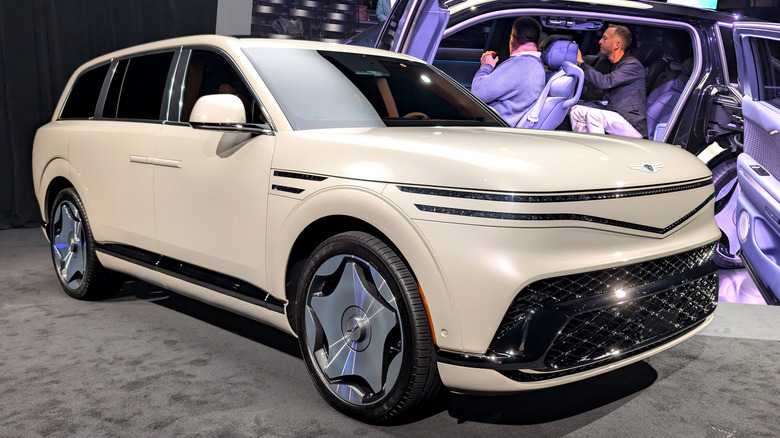
- The electric Genesis GV90 combines coach doors, swivel seats, and a properly plush cabin.
- The 657 hp flagship claims around 311 miles of range from a 123.5-kWh battery.
- Genesis hasn't announced U.S. pricing, and that could make or break the entire proposition.
Update: Our own Stephen Rivers was on the ground for the GV90's debut in San Francisco and has sent through a set of live photos, which we've added below. They show the production model from angles the official gallery skipped, including a closer look at the cabin and the detailing around the grille and lighting signature.
Genesis has spent a decade proving it can make luxury cars that belong in the same sentence as BMW, Mercedes, and Audi. The GV90 might be the vehicle that lets it start a much louder conversation. At least on first look, this thing is seriously good. It's big, clean, properly expensive-looking, and its cabin appears to have been designed by people who understand that a flagship SUV should feel like more than a row of screens wrapped in quilted leather. There's just one big catch, though: Genesis has yet to say how much it will cost.


That matters because the GV90 is not another slightly nicer electric SUV. It's Genesis' new flagship, a 208.1-inch-long electric luxury barge with a 127.8-inch wheelbase, 657 hp, 590 lb-ft (800 Nm) of torque, a 123.5-kWh battery, air suspension, rear-wheel steering, and dual electronic limited-slip differentials. The company says its seven-seat version can travel roughly 500 km, or 311 miles, on a charge, although that figure comes from internal testing rather than the EPA. Oh, and that's before we get to the interesting bits.
The Coach Doors Aren’t Just A Party Trick

The range-topping GV90 Neolun gets what Genesis calls the Neolun Arch Gate. These are coach doors with no conventional visible B-pillar. It's the sort of thing that looks great in a concept-car rendering and usually disappears before production because engineers, crash regulations, and reality tend to get involved. That's not the case here.
Read: Genesis' Entry-Level Crossover Is Getting A Hybrid Makeover
Genesis says it has made the arrangement work by integrating high-strength steel beams into the door-and-body structure. In addition, it's added a concealed roll-cage-like arrangement with thicker framing, steel tubes, and structural foam. The rear door also uses a dual-motion hinge that first pushes it outward before it swings open, allowing it to operate independently rather than requiring the front door to be opened first.


In practice, it's more impressive than it might, at first, seem. Getting into the second row is far more classy and seamless than in pretty much any other SUV at this price point. The experience matters, and it's pretty special here. Still, this is one of those cases where the engineering explanation matters as much as the visual effect. We still need to drive and test one of these in the real world to get a better idea of everyday pleasures and pain points.


The standard GV90 uses conventional swing doors, which may end up being the smarter choice for many buyers. But the Neolun gives Genesis a proper halo feature that BMW, Mercedes, and Audi don't have. Quite simply, it adds a layer of luxury that only brands like Rolls-Royce offer, but possibly for hundreds of thousands less.


The cabin may be the GV90's real knockout punch. Genesis describes it as a "bespoke living space," which is normally the sort of phrase that should trigger an immediate eye roll. Here, though, the experience, again, the most important part, makes a convincing case.
There's a wide pop-up OLED display that expands from 23.6 to 24.6 inches when parked, a 25-inch head-up display in place of a conventional instrument cluster, real-glass crystal controls, motorized vents, a 25-speaker Bang & Olufsen sound system, and seats with 15 air cells and pulse-vibration massage functions.


Then there are the motorized swiveling front seats. While parked, they can rotate a full 180 degrees to face the second row. That turns the GV90 Neolun into an actual lounge rather than a brochure's vague promise of one. A 1960s Imperial and a Mercedes camper van are about the only U.S.-market precedents for front seats that fully face rearward. Genesis is bringing the idea to a modern luxury SUV.
Add the available four-seat Executive Suite with real wood flooring, a refrigerator, tables, a partition, and a six-zone electronically tintable roof, and Genesis is plainly aiming at the sort of buyer who sees a long drive as an opportunity to disappear from the world for a while. That's also where the electric powertrain makes real sense.
Nobody buying a six-figure GV90 is likely trying to figure out public charging while living paycheck to paycheck in an apartment complex. These buyers are more likely to have home charging, other vehicles, and the means to arrange their lives around the rare trip that exceeds an EV's comfort zone. In return, they get the silence, smoothness, instant torque, flat-floor packaging, and general serenity that make an EV particularly well suited to a luxury flagship.


But that doesn't mean the EV-only decision is risk-free. A buyer cross-shopping a Mercedes GLS, BMW X7, Range Rover, or gas-powered Escalade may still want the freedom to drive all day, tow without anxiety, or simply avoid planning around charging. Genesis is betting those compromises will matter less than the benefits of an electric flagship. For its target customer, it may be right. But it is still leaving some very wealthy people on the table.


The market has already set some uncomfortable benchmarks. Lucid's Gravity Touring starts at $79,900, while Cadillac's Escalade IQ begins at more than $127,000. The Kia EV9 starts far lower, though it isn't a genuine equivalent; the Genesis is roughly 11 inches longer and uses a flagship-exclusive eMP platform.
Read: Genesis' Magma GT Supercar Concept Edges Closer To Production
That leaves Genesis with a narrow but potentially lucrative lane. If the standard GV90 starts around $100,000, it could look like an astonishing amount of luxury SUV for the money. Push it into the $120,000 range, though, and the brand will have to justify not only the vehicle itself, but also the entire Genesis ownership experience. At that point, buyers won't just compare leather quality, rear-seat space, and charging times.


They'll compare dealer treatment, service convenience, resale confidence, and whether the Genesis badge carries enough weight beside a three-pointed star or a Range Rover grille. The Neolun, and especially the four-seat First Edition, can probably command more. Those are the versions for buyers who want something their neighbors cannot casually duplicate. But the regular GV90 has the chance to be the important one.
Genesis may have built the kind of flagship SUV that makes the established luxury players uncomfortable. It looks fantastic, the interior feels genuinely special, and the coach doors, wood flooring, and rotating seats give it a personality beyond another expensive electric SUV with a giant screen. Now we just need Genesis to put a number on it. That number will decide whether the GV90 is a masterstroke or merely a very handsome missed opportunity.


