

New Dacia Spring EV Flees From China And Pays The Price
The new model is manufactured in Europe, riding on an EV-dedicated, Renault-sourced architecture
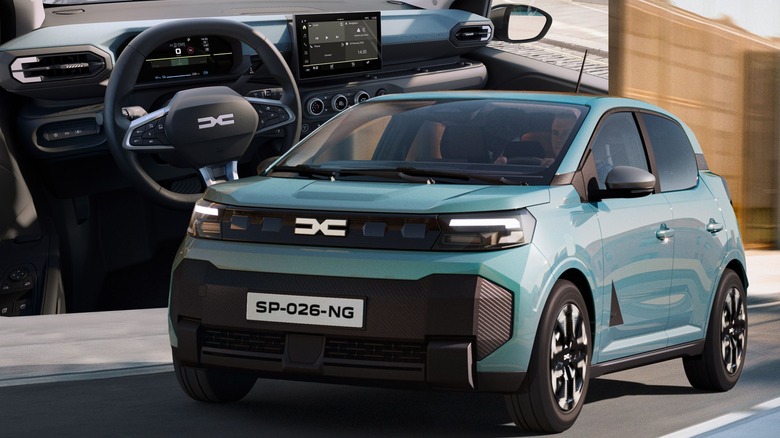
- New Dacia Spring is a Euro-made budget-friendly urban EV.
- It has a Renault platform, 80 hp and a 155-mile WLTP range.
- The entire lineup will be priced under €20k before subsidies.
Dacia has unveiled a new generation of the Spring, marking a complete overhaul for one of Europe's most affordable urban EVs. The small hatchback is built on Renault bones, promising a 155-mile range, clever design features and a sub-€20k ($23k) price tag. Unlike its Chinese-built predecessor, the new Spring will be manufactured in Slovenia, avoiding import tariffs in Europe.
The new model swaps the aging CMFA-EV platform of its predecessor for the new RG-EV architecture. This is another name for the AmpR Small platform, already underpinning the Renault Twingo E-Tech, Renault 5 E-Tech and Nissan Micra hatchbacks.
More: Dacia's Sub-$28K Striker Claims To Be Three Cars At Once


Power comes from a Twingo-sourced electric motor producing 80 hp (60 kW / 82 PS) and 175 Nm (129 lb-ft) of torque, sending power to the front wheels. The 0-100 km/h (0-62 mph) sprint is completed in 12.1 seconds and top speed is limited at 130 km/h (81 mph). Energy is stored in a small 27.5 kWh Lithium Iron Phosphate (LFP) battery pack, offering up to 250 km (155 miles) of WLTP range.
The battery needs 28 minutes to charge from 15-80% when connected to a 50 kW DC fast charger, or 2 hours and 55 minutes from a 7 kW wallbox using the standard AC charger.


The shift to the new platform gives the urban EV different proportions and a larger footprint while keeping weight low at 1,212 kg (2,672 lbs). The new Spring is 150 mm (5.9 in) longer and 180 mm (7.1 in) wider compared to its predecessor, stretching to 3,850 mm (151.6 in) long. It is also 61 mm (2.4 in) longer than the Renault Twingo E-Tech twin, while adopting a different styling language.
More: Renault Shipped 100 Frog-Eyed Twingos To The UK Purely So You Can Stare At Them
Unlike the Renault which is known for its frog-style headlights and soft curves, the Dacia looks less playful and more utilitarian. Designers gave it boxy LEDs, a generous amount of plastic cladding on the bumpers, conventional door handles and steel wheels measuring 15 or 16 inches in diameter.


Inside, the larger body translates to a more spacious cabin although the model retains the four-seater layout. The cargo space has a capacity of 337 liters (11.9 cubic feet) and grows to 1,283 liters (45.3 cu ft) when folding the 50/50 split rear bench. Dacia has also added a optional 18-liter (0.6 cubic feet) frunk, plenty of storage solutions around the cabin, and the modular YouClip accessory mounting system.
More: Renault's New Duster Looks Like An Expensive Dacia, Until You See The Price


The dashboard appears to be covered in hard plastics with a large piece of colorful trim above the practical tray breaking the monotony of black. The standard 7-inch digital instrument cluster is joined by a 10.1-inch infotainment display on the flagship Journey trim, although the entry level Expression will be limited to a smartphone mount.
Occupants are treated with fabric seats and scratchy plastics on the door cards, designed to keep the costs low. Finally, the model has a familiar "My Safety" button allowing the driver to quickly disable or enable ADAS.


Production of the new Dacia Spring takes place at the Novo Mesto plant in Slovenia alongside the Renault Twingo E-Tech. The market launch is expected in late 2026, with the first deliveries scheduled for early 2027. Dacia has yet to announce detailed pricing but confirmed that all variants will cost under €20,000 ($23,000) before local EV subsidies.
More: Opel's Cheapest New Car Is Now A Family SUV With Three Pedals And Steelies
This suggests that the new model will be more expensive compared to the outgoing Chinese-built Spring, which started from a heavily discounted €11,900 ($13,800) in Germany earlier this year. The latter will remain on sale alongside the new generation for a transitional period, serving as a cheaper alternative.
The new Spring is one of four new Dacia EVs set to debut by 2030 according to the official roadmap, including the upcoming Sandero EV with a slightly larger footprint.


