

What Does 'RX' Actually Stand For On A Lexus RX 350?
This letters of this long-running SUV simply mean "Radiant Crossover"
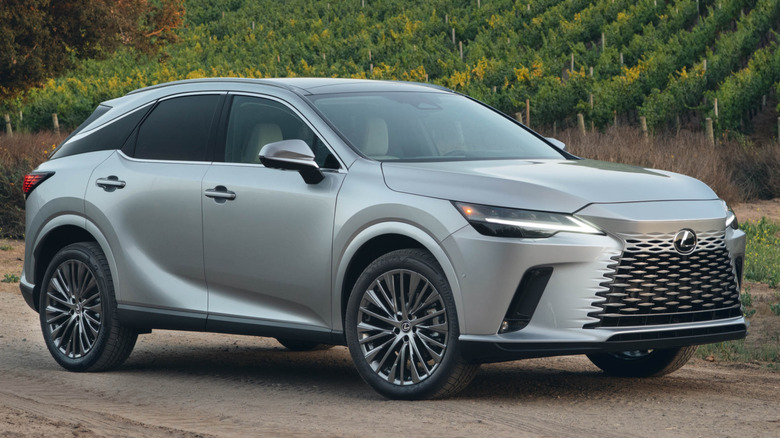
Lexus models have graced our streets and driveways for nearly four decades, including the long-running, and recently updated LS flagship. But many automotive enthusiasts, including owners, are still unaware of the exact meaning behind the two-letter model designations for its lineup, which are often followed by a series of numbers. The global best-seller of the Japanese brand is the Lexus RX, which will be refreshed for 2028, and is positioned in the midsize SUV segment.
The model was originally introduced back in 1998, with generational updates following in 2004, 2010, 2016, and 2023. According to Lexus, the RX name officially stands for "Radiant Crossover". At the verge of the new millennium, the company chose the word radiant to represent its "bright new future" and simply stuck with it until present day. The X for "Crossover" is pretty self-explanatory, and signifies the market positioning of the model between luxury sedans and genuine off-roaders.
Numbers don't always tell the full story
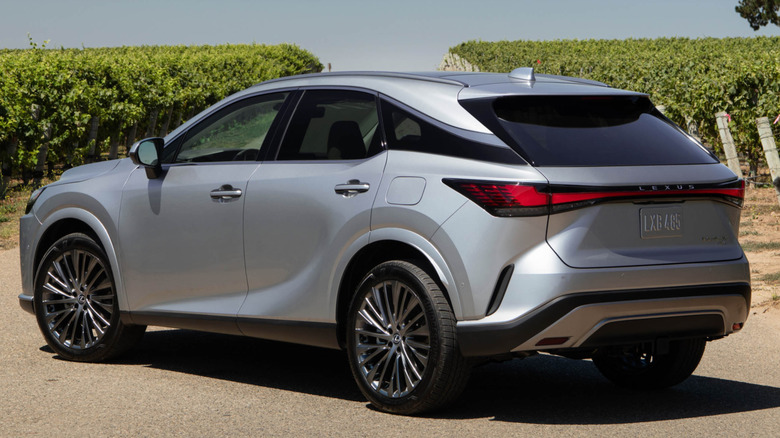
As with other luxury brands, the three-digit number following the letters is a hint about what lies under the hood. However, in the current Nürburgring-tuned RX generation, these numbers are not directly linked to engine displacement. For example, while the original RX 300 had a 3.0-liter V6, the current RX 350 is powered by a turbo 2.5-liter four-cylinder mill. The ICE-powered RX 350 is joined by the hybrid RX 350h and the plug-in hybrid RX 450h+, both employing electrified 2.5-liter four-cylinder powertrains.
As for the flagship RX 500h F Sport Performance, its name might bring to mind Lexus' discontinued 5.0-liter V8, but it actually uses a hybrid turbo 2.4-liter unit with a combined output of 366 horsepower. Recent spy shots suggest that Lexus is working on a GR version of the RX. This one could feature the Morizo RR badge with the blessings of Gazoo Racing. Besides adopting a lower and wider stance, the upcoming performance SUV is rumored to produce as much as 600 hp from a hybrid setup comprising a new 2.0-liter engine and dual electric motors.
What about the rest of the lineup?

The "Radiant Crossover" moniker is part of a homogenous naming hierarchy across the entire Lexus portfolio. All have their own meanings, with some being cooler than others. The entry-level LBX, which is not available in the U.S., is short for "Lexus Breakthrough Crossover". Moving up the ladder, UX stands for "Urban Crossover", the NX for "Nimble Crossover", and the TX for "Touring Crossover". The fully electric RZ is similar to the RX, as it stands for "Radiant Zero", signifying the fact that it produces zero emissions.
As for the more rugged ladder-frame models, the GX stands for "Grand Crossover" and the flagship LX for "Luxury Crossover". Lexus applies the same logic to its sedan lineup including the IS (Intelligent Sport), the ES (Executive Sedan), and the LS (Luxury Sedan). At the top end of the lineup we also find the LC (Luxury Coupe) grand tourer and the LM (Luxury Mover) minivan. Finally, the F and F Sport variants reference the Fuji Speedway in Japan where Lexus' master drivers fine-tune each model's driving dynamics.