

VW Refreshes Its Smallest Sedan, But It's Still Forbidden Fruit
Unless you live in India, of course
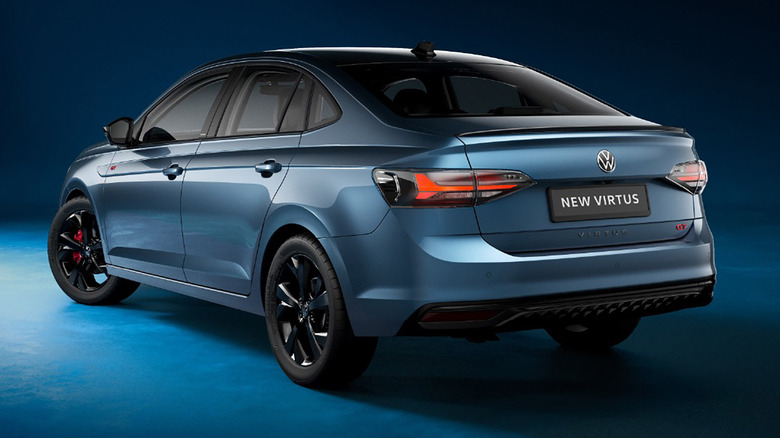
Volkswagen might be ready to axe the ICE-powered Polo from its European lineup in favor of the electric ID Polo, but its sedan sibling is alive and kicking in India. The VW Virtus is set to receive another update, with subtle styling changes and improved equipment mirroring its recently facelifted Skoda Slavia twin.
The VW Virtus was originally introduced in late 2017, looking like a stretched Polo sedan. In 2022, the model arrived in India with a comprehensive facelift adopting distinct styling features and more technology. However, competition in the subcompact sedan segment is strong, prompting VW to update its offering in late 2026.
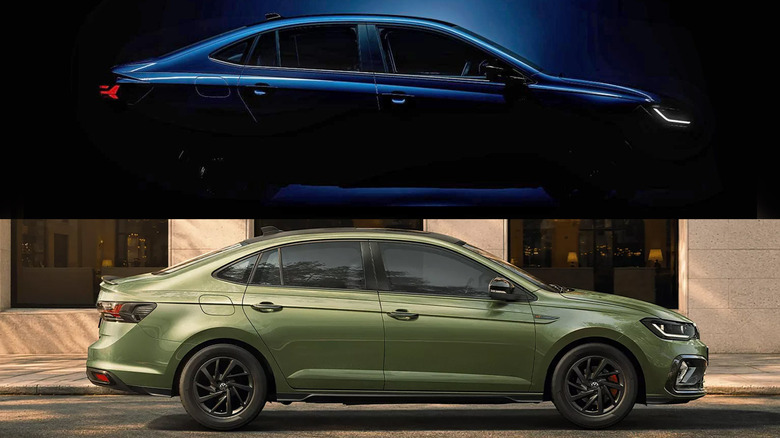
Following a revealing teaser, the automaker has shared the first official photos of the updated Virtus ahead of its market launch in India next month. The exterior design looks instantly recognizable, but a closer look reveals a few changes. The lower portion of the front bumper has been redesigned with a new mesh for the intakes, smaller fog lights, and body-colored inserts, paired with carry-over grille and headlights.
The profile is largely unchanged, though VW added a new set of black alloy wheels and a fresh blue shade that contrasts with the red brake calipers on the flagship GT trim. Around the back, changes are limited to slightly different taillight graphics and black trim on the rear diffuser. In terms of footprint, the outgoing Virtus measures 179.6 in (4,561 mm) long, which is 5.6 in (141 mm) shorter than the U.S.-spec Jetta.
Powertrains and technology
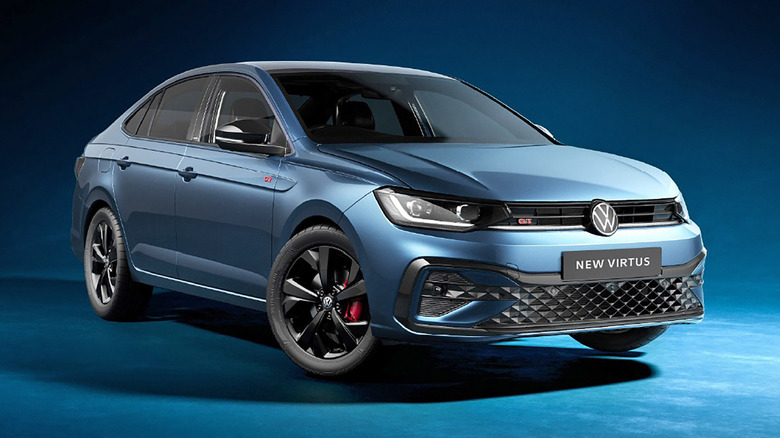
The first photos depict the Virtus GT trim, which is the sportiest and most expensive member of the lineup. VW didn't share the specifications, but the sedan is expected to retain the turbo 1.5-liter TSI four-cylinder engine, which is rated at 148 hp (110 kW / 150 PS) and is mated to a seven-speed DSG dual-clutch automatic. Another option is the entry-level turbo 1.0-liter TSI three-cylinder engine producing 113 hp (85 kW / 115 PS), mated either to a six-speed manual transmission or a new eight-speed torque converter automatic.
It remains to be seen whether VW engineers made any changes to the suspension setup of the localized MQB-A0-IN architecture, which also underpins the Skoda Slavia/Kushaq and the VW Taigun. Judging from the interior of the recently facelifted Slavia, the Virtus will likely get the same 10.1-inch infotainment display with AI-infused software and a larger 10.25-inch digital instrument cluster with new graphics. The current Virtus already comes with ventilated seats, wireless charging, and six airbags, but the update might bring more features such as rear massaging seats and a 360-degree camera.
Sales and availability
VW recently marked the four-year anniversary of Virtus sales in India, noting that nearly one unit has been sold every 24 minutes since 2022, with high demand for the flagship GT trim and automatic transmissions.
The company will announce the detailed trim structure and pricing for the updated Virtus closer to its market launch, expected in December 2026. The outgoing model starts at ₹1,070,900 Indian Rupees ($11,300) and tops out at ₹19,19,900 Indian Rupees ($20,300) for the limited production Virtus Anniversary Edition.
Besides India, the updated Virtus might reach Latin America over the next few years, although with market-specific features. The ICE-powered sedan is designed primarily for emerging markets, so it will remain forbidden fruit for buyers in North America where the larger Jetta remains VW's entry-level sedan. In Europe, the only VW-branded sedan is the fully electric ID.7, as the Passat has transitioned to an estate-only lineup.