


CONS ›› Cheap cabin, outdated tech, questionable reliability
The Alfa Romeo Giulia Quadrifoglio has always done things a little differently. It arrived in 2015, shortly after BMW rolled out the F80-generation M3, packing an Italian-built, Ferrari-derived V6 that walked away from the Bimmer on output and put the Alfa in a fairer fight with the twin-turbo V8 in the Mercedes-AMG C 63 S of the era.
Review: Porsche’s 1,139-HP Cayenne Turbo Electric Is A Supercar In Family-SUV Clothing
It has also always been a performance car which exudes passion, sporting a design the German competition has never quite matched, but even when it was new, it never sold in the same kind of numbers as the M3 or the C 63, despite its brilliance.
QUICK FACTS
A lot has changed in the 11 years since the Giulia Quadrifoglio’s debut, including BMW launching the popular G80 M3 and Mercedes-AMG turning the C 63 into a plug-in hybrid four-cylinder. By every traditional measure, it’s outdated, especially in a market that develops as quickly as this one. Alfa Romeo had planned to kill off the car last year, but changed its mind and will continue selling it through next year.
Read: Alfa’s Yacht-Winged Giulia Quadrifoglio Special Is Fast, Wild, And Already Sold Out
Eager to see whether the flagship Giulia still makes sense or is starting to feel like a relic, we recently spent time with the 2026 model. For as excellent as it is, it’s not quite the same proposition it was when it first hit the market.
Frozen In 2015



Photos Brad Anderson/Carscoops
Aside from a minor midlife facelift, very few updates have been made to the Giulia since it hit the market. The Quadrifoglio continues to use the same fabled 2.9-liter twin-turbocharged V6, positioned beneath the same shapely, lightweight carbon-fiber hood it’s always had.
In Australia, where we conducted this review, the range-topping Giulia starts at AU$156,990 (US$112,000) excluding on-road costs, or a touch over AU$170,000 (US$121,000) including all fees. Sadly for our US readers, local sales of both the Giulia and Stelvio Quadrifoglio models ended in mid-2024, so prospective owners will have to look at the used car market.
By Alfa Romeo standards, the Giulia Quadrifoglio is extraordinarily expensive, but it’s much cheaper than the competition. For example, Aussies will need to fork over at least AU$190,888 (US$136,300) for an entry-level BMW M3 with rear-wheel drive and the lower-spec engine, or AU$210,291 (US$150,200) for the M3 Competition xDrive. The supremely unpopular Mercedes-AMG C 63 S E Performance is even more expensive, costing AU$218,644 (US$156,100), including fees. Compared to that car, the Alfa Romeo seems like a bit of a bargain.
An Interior Out Of Its Depth


Photos Brad Anderson/Carscoops
While the exterior of the Alfa Romeo has aged gracefully over the past decade, the cabin is showing its age. Visually, the design and layout are quite nice, but the technology and the quality of the materials are far behind the BMW and Mercedes.
Perhaps the cabin highlight is the 12.3-inch infotainment display, which, unlike so many other new cars on the market, isn’t just a rectangle. Instead, it’s set up like an analog cluster, even surrounded by a traditional shroud, eliminating any unwanted reflections and sun glare.
While the screen is nice, the software used leaves a little to be desired. There are a handful of different displays that vary by drive mode, but I would like to see more customization options. Similarly, the 8.8-inch infotainment screen is pretty basic, even though it’s clear and the menus are easy to follow.
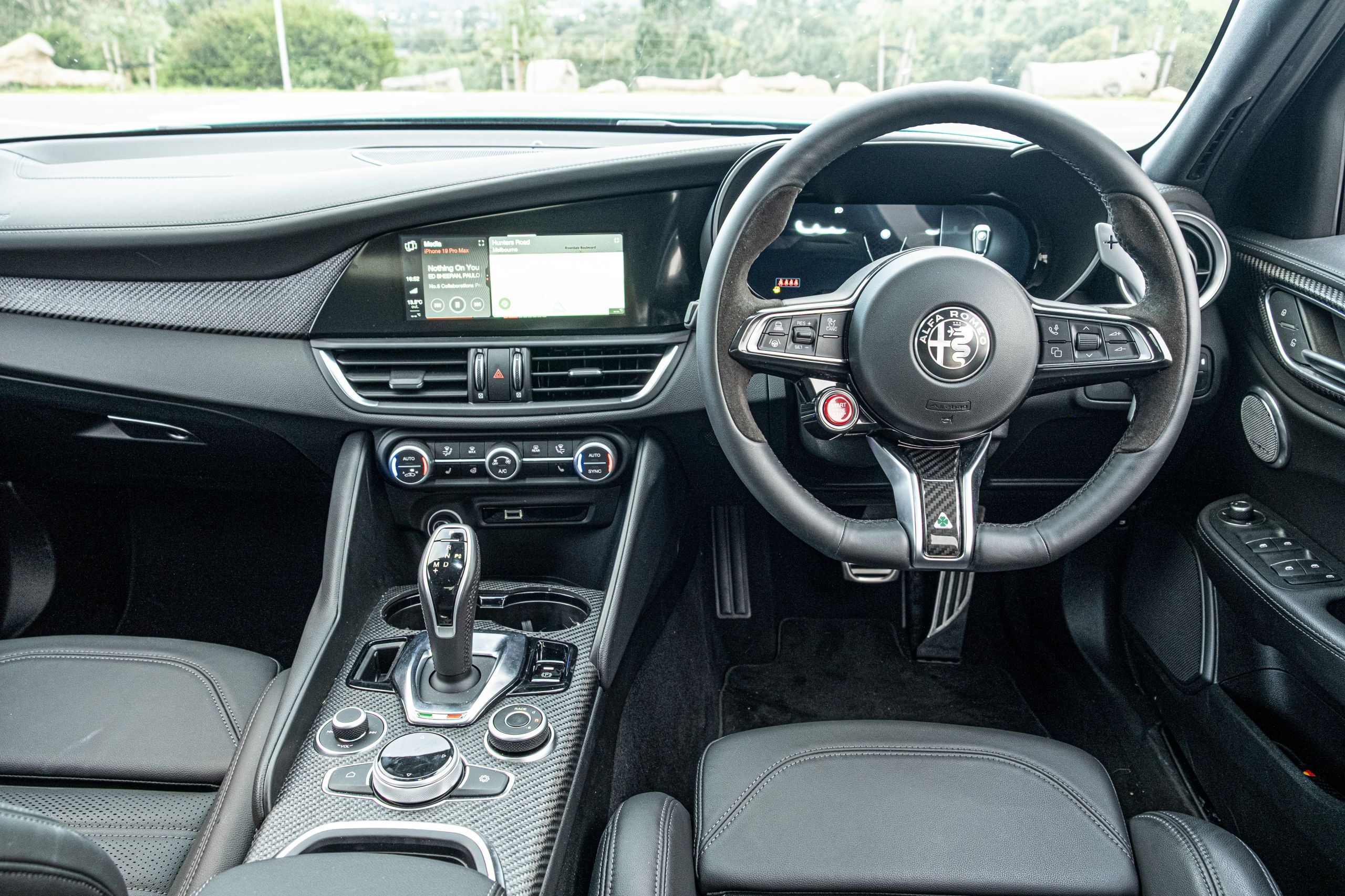
Then there’s the overall cheap feeling of the interior. The plastic climate-control dials and vents are budget specials, as are the gear selector and the physical controls for the infotainment screen. While I did appreciate the raw carbon fiber on parts like the door panels and transmission tunnel, nothing about the Alfa Romeo’s interior feels as special or as premium as a G80 M3.
Thankfully, my Montreal Green test car didn’t suffer from any of the same audio issues I experienced a couple of years ago. There’s also a lot to like about the car’s interior, most notably the Alcantara accents on the steering wheel and the superb aluminum paddle shifters. The driving position is also spot-on, although I’d love to see Alfa Romeo offering the more hardcore bucket seats of the GTA and GTAm models on the regular car.
Viewed in isolation, the interior of the Giulia Quadrifoglio would be decent enough for a vehicle costing around AU$60,000, but for one at this price point, especially when compared to an M3 or C 63 S, it’s barely passable. Fortunately, anyone who has had the pleasure of driving this car will understand that any qualms about the cabin fade into insignificance when you start driving.
The Engine Is Still The Main Event
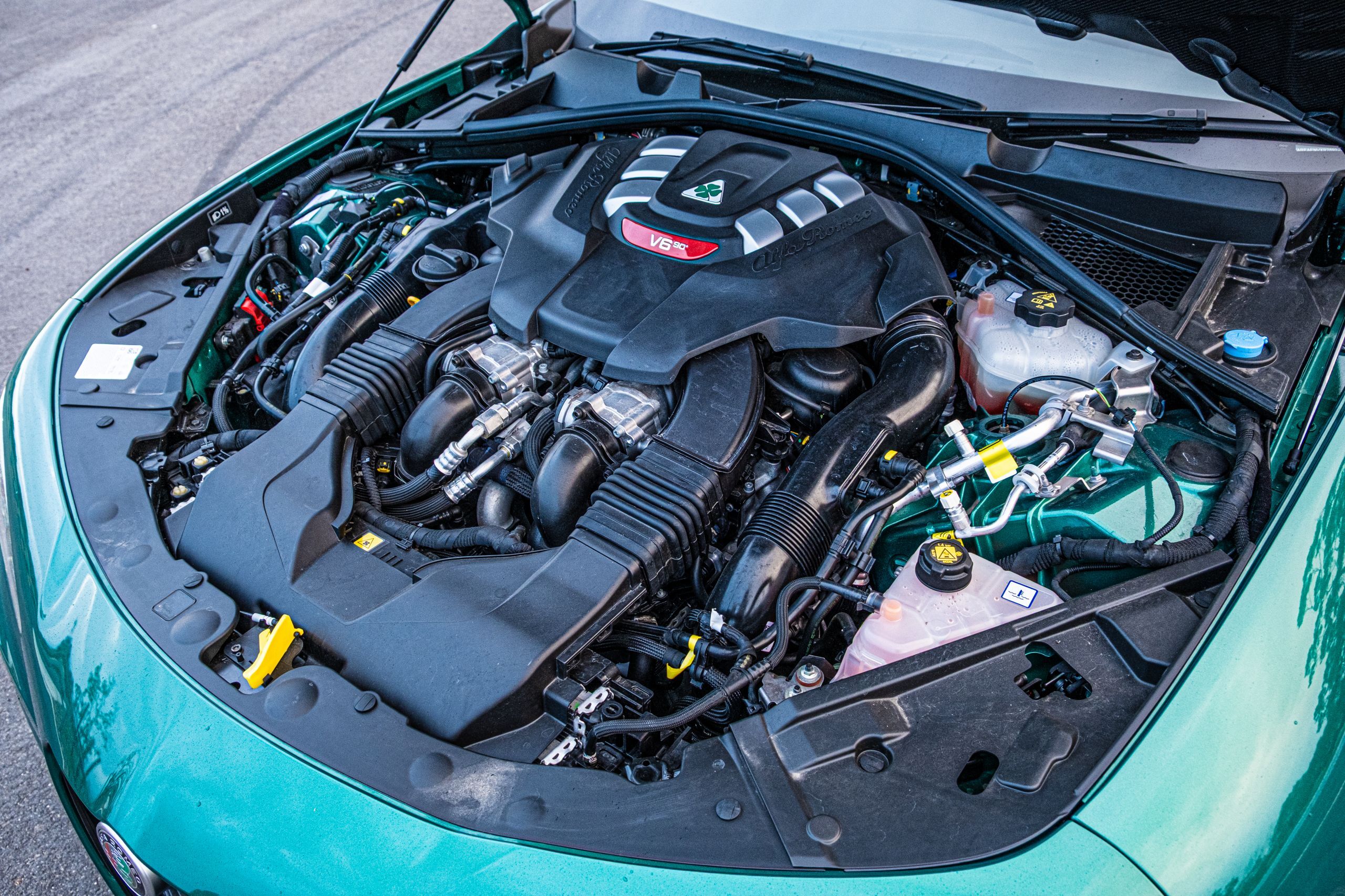
The 2.9-liter twin-turbo V6 powering this beast has always been fantastic, and it remains so. Obviously, it’s way more evocative than the turbo-four of the C 63 S, and is more characterful than the M3’s inline-six.
With 375 kW (503 hp) and 443 lb-ft (600 Nm), the Giulia Quadrifoglio still manages to mostly match an M3 Competition, despite the engine being more than a decade old. Coupled to an eight-speed automatic transmission that drives the rear wheels, it’s hard to think of a powertrain combination that’s more exciting than this one.
This thing is absolutely rapid, to the point where it can feel a little scary, particularly when driving it in the depths of winter with Pirelli P Zero Corsa tires. Unlike the competition, there’s no fancy all-wheel drive system here, so you do have to manage throttle inputs when driving in Race mode, as it turns off both the traction control and stability control systems.
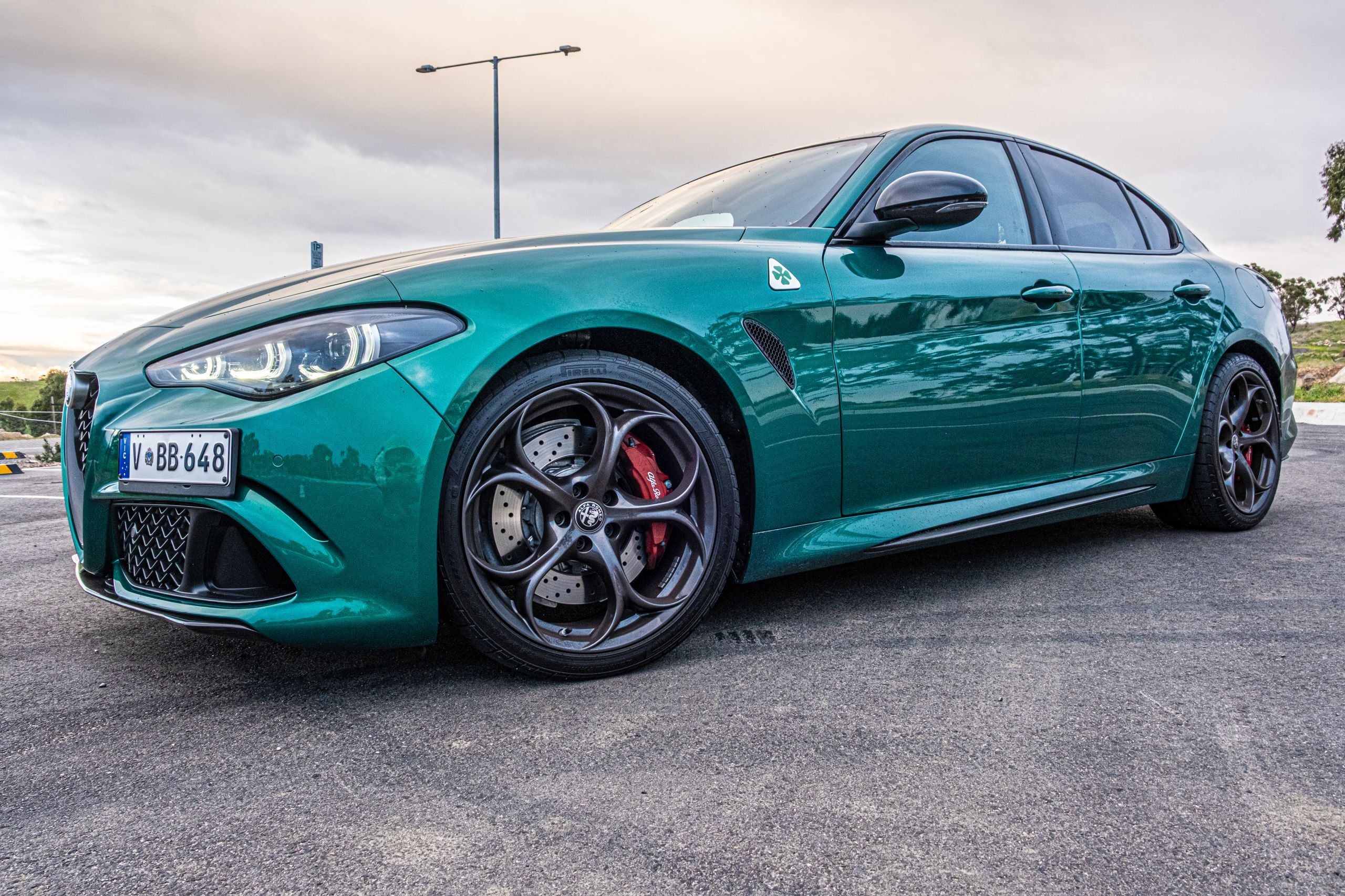
The last Giulia Quadrifoglio I tested had Michelin Pilot Super Sport tires, which instilled much more confidence than these Pirellis. At times, the Pirelli rubber would stick into the pavement, firing me off into the distance, while on other occasions, the Alfa Romeo struggled to put its power to the ground through the first two gears. With this in mind, I didn’t drive in Race mode all that often, which was a shame, as that’s the only mode where the exhaust flaps remain open all the time.
Alfa Romeo quotes a 0-100 km/h (62 mph) time of 3.9 seconds. I wasn’t able to verify that time, but I have no doubt it’s achievable on a grippy piece of pavement.
The transmission is an excellent companion to the V6, providing quick changes when you need them. However, despite being a traditional torque converter, it can be quite rough and jerky when changing into first and at low speeds using the manual mode, just like a dual-clutch. It is slightly smoother when left in automatic mode.
The M3 Wins The Drag Race, The Alfa Wins The Corner


Photos Brad Anderson/Carscoops
In a straight line, an M3 with all-wheel drive will walk a Giulia Quadrifoglio. However, where the Alfa Romeo still feels like a class leader is in the handling department.
The first part of the recipe is the steering. The car has an ultra-quick steering ratio of 11.8:1, which works out to 2.3 turns lock-to-lock. It takes a bit of getting used to, as just small steering inputs have a big impact on how much the car turns. On a mountain road that’s a gift. On a highway it means resisting the urge to fidget with the wheel.


Photos Brad Anderson/Carscoops
Feedback through the steering wheel is good, but not excellent, as it can feel a little vague. Countering this are superb levels of grip at both the front and rear axles, and a neutral balance and lightweight feel that the competition still can’t quite replicate.
The brakes are also excellent, providing immense initial bite and never show any signs of stress, despite how much we pushed them. Annoyingly, the brakes on our tester squealed a lot at low speeds, even though there appeared to be plenty of pad material left. Further boosting the package are the active dampers, which provide different comfort levels across the Normal, Dynamic, and Race driving modes. Even with the firmest setting, they’re compliant enough for daily use.
Verdict


Photos Brad Anderson/Carscoops
The Alfa Romeo Giulia Quadrifoglio isn’t the best option for those in the market for a high-end sports sedan, as the G80 M3 still holds that crown. Yes, it’s more expensive, but it does justify the higher price tag with a much better cabin, greater build quality, and proven reliability, something which isn’t a strong suit of any Alfa Romeo.
With that said, the Giulia remains a seriously impressive package and still feels relevant despite its age. I probably wouldn’t buy one if I was in the market for a high-po sedan, but I wouldn’t blame anyone who does.