









- The annual MOT tests inspect vehicles for safety, roadworthiness, and emissions.
- The inspections look at items such as brakes and suspension, but not battery health.
- EVs were more likely to have tire and brake defects compared to ICE cars.
In news that is sure to either surprise or delight you, depending on where you sit on the EV vs ICE divide, a recent study from the U.K. has found that high-mileage electric cars are more reliable than their combustion counterparts. On the face of it, the evidence flies in the face of those put off by higher-mileage EVs, due to concerns over wear and tear.
However, there’s an important catch: the study was carried out using the UK’s MOT test data. While the sample size is impressive, with 47.4 million MOT tests analyzed, you do need to remember what the inspection looks out for and, importantly, what it doesn’t.
Read: The Priciest Repair On A Used EV Isn’t The Battery
An MOT is a legally required annual test for cars over three years of age registered in the U.K. It ensures a car meets minimum standards of safety and emissions. What an MOT doesn’t do is test things like an EV’s remaining battery capacity or recharging health. Similarly, for an ICE car, it doesn’t factor in engine performance or the condition of a vehicle’s transmission.
What The Data Says
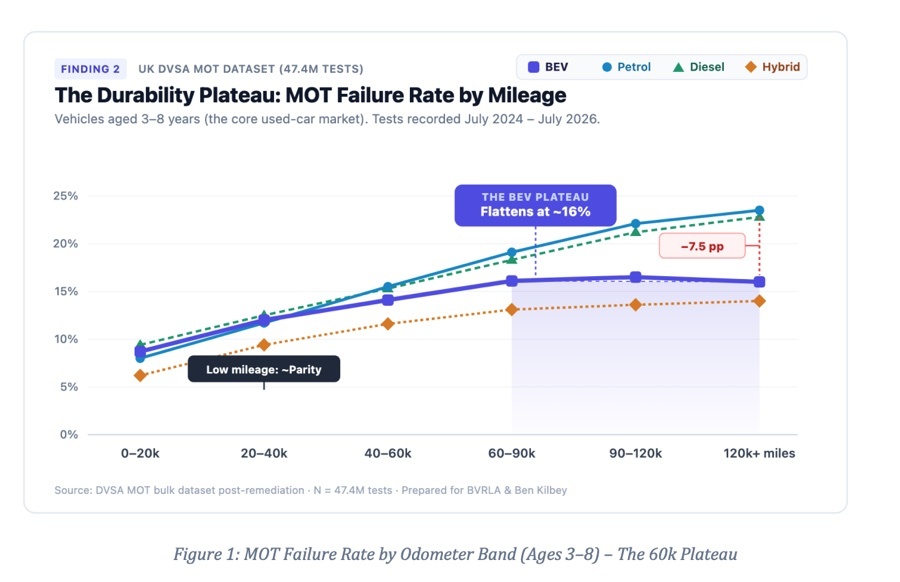
While it may not paint the whole picture, there is some merit to the study, suggesting that high-mileage EVs shouldn’t necessarily be skipped over when browsing the classifieds. The research, which was carried out by transport consultancy New AutoMotive and commissioned by the British Vehicle Rental and Leasing Association (BVRLA), was carried out on cars aged between three and eight years old.
For EVs with between 90,000-120,000 miles (145,000-193,000 km), only 16.5 percent failed. Compare that with 22.1 percent of combustion-powered cars, and that’s a 25 percent lower relative rate. The gap between the two drivetrain types increases the more miles are added. For EVs that had more than 120,000 miles on the odometer, the MOT test failure rate stayed roughly constant, with 16 percent failing, while ICE vehicles had a higher failure rate of 23.5 percent.
The study also found that, at lower mileages, the difference between electric and combustion was negligible. Between 20,000-40,000 miles / 32,180-64,370 km the EV failure rate was 12 percent, with ICE cars at 11.7 percent.
The Full Picture
On the failure rate alone, it would appear that high-mileage EVs aren’t as unreliable as their gas-powered alternatives. However, as an MOT test doesn’t factor in battery health, one of the largest components of high-mileage EVs wasn’t accounted for. An MOT test still checks safety and wear items, including tires, steering, suspension, brakes, lights, and the condition of a vehicle’s structure.
However, wear items are still a big concern. The research found that EVs recorded nearly twice as many tire defects as ICE vehicles. In lower-mileage EVs, brakes were also flagged. This was likely due to the fact that EVs mainly rely on regenerative braking, meaning that the friction brake components were less likely to be used as much, and therefore more susceptible to corrosion-related wear.
See Also: After 62,000 Miles, The Healthiest EV Battery Belonged To A Kia, Not A Tesla
While the research was carried out by the independent transport consultancy New AutoMotive, it’s also perhaps prudent to note who commissioned the study. The British Vehicle Rental and Leasing Association (BVRLA) represents over 1,000 companies operating within the UK’s vehicle rental, leasing, and fleet management sectors. Many of those companies likely have fleets of high-mileage EVs ready to enter the used car market.
“The important thing about this study is that we can separate age from mileage,” said Ben Nelmes, chief executive at New AutoMotive, speaking to Fleet News. “Looking simply at the headline MOT numbers gives a misleading picture because Britain’s electric cars are much younger than its petrol and diesel fleet, while comparing cars by age alone misses the fact that EVs have typically covered considerably more miles.”
“Once we compare cars of the same age and mileage, something striking happens. At lower mileages, there is very little between petrol and electric cars, but beyond around 60,000 miles (96,560 km) the failure rate for EVs flattens while the petrol failure rate continues to rise. High mileage isn’t a proxy for poor condition in the way buyers have traditionally assumed. The data suggests the mechanical simplicity of an electric drivetrain starts to become increasingly valuable as cars accumulate miles.”